
As a magazine devoted to making you a better baker, we wish that we were all on a level playing field. But if you live in Denver, Colorado, Santa Fe, New Mexico, or one of the many other mile-high cities, you know you’re working with a different level of pressure—literally. Recipes that are developed at sea level, like those in Bake from Scratch, don’t always make a smooth jump to the land of rarefied air. It’s time we set our sights higher. We’re breaking down the hows and whys behind adjusting a recipe for high-altitude baking, translating the science into practical troubleshooting. Because with baking, the sky’s the limit.
High-altitude baking can be chalked up to one main factor: low air pressure. Low air pressure affects two aspects of your baking: how quickly it rises (faster) and how quickly it loses moisture (also faster). Leavening agents, from sourdough yeast culture to chemical leavens, work fast and furious in low-pressure environments. Bread proofs faster, and in worst-case scenarios, the bubbly network of gases will pop and collapse under such rapid growth. For moisture, consider that at sea level, water boils at 212°F (100°C), while at 5,500 feet above sea level (the elevation of Denver), water boils at 202°F (94°C). Ten degrees may sound negligible, but your sensitive batters and doughs can feel the difference, drying out much faster. They’ll also take longer to bake, needing more time in the oven to set up. We’ll break down how each of these things effects specific baked goods below, but keep in mind these two main enemies when battling low pressure: gases expanding too fast and accelerated loss of moisture.
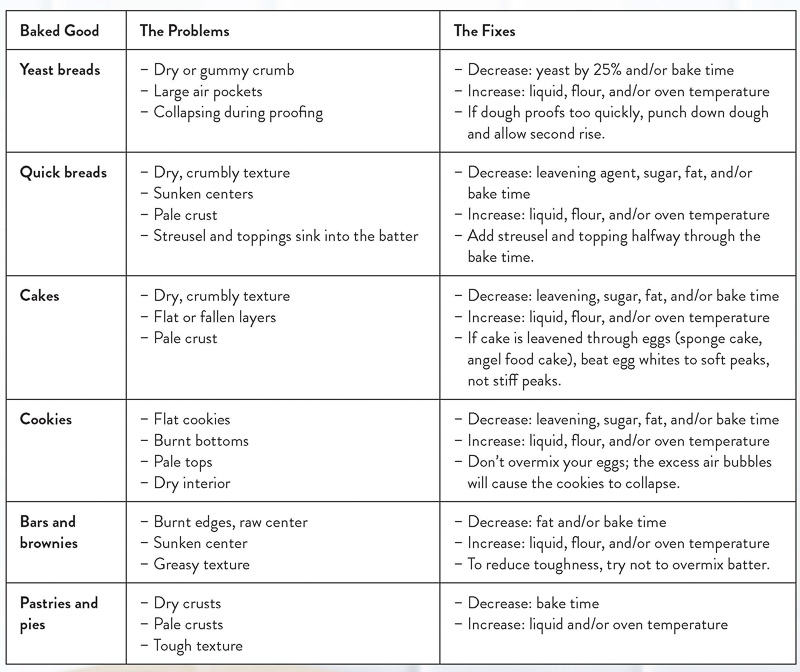
The following charts are here to help you troubleshoot recipes, not reinvent them. Many recipes will work well at high altitudes without any adjustment. But if you’re running into issues, use our charts as a new plan of attack. Start small, making one or two adjustments per recipe, like adjusting temperature/bake time and decreasing the sugar. This is all about tinkering and testing until you get the perfect result.