

Vanilla Bean Macarons with Strawberry Buttercream

A traditional French meringue receives a gentle fold-in of confectioners’ sugar and superior Bob’s Red Mill Super- Fine Almond Flour to create the most delicate and delicious macarons. Filled with a bright and blushing pink Strawberry Buttercream, these macarons are made with an accessible recipe that’ll usher you into the sweet art of French pâtisserie.
- 1¾ cups plus 3 tablespoons (231 grams) confectioners’ sugar
- 1½ cups (144 grams) Bob’s Red Mill Super-Fine Almond Flour
- ¼ teaspoon kosher salt
- ½ cup (120 grams) egg whites, room temperature (about 4 large egg whites)
- 3½ tablespoons (42 grams) granulated sugar
- 1 teaspoon (6 grams) vanilla bean paste
- ¼ teaspoon (1 gram) vanilla extract
- Strawberry Buttercream (recipe follows)
- Line 2 to 3 rimmed baking sheets with nonstick baking mats. Using a permanent marker, draw 1½-inch circles 1 inch apart on a sheet of parchment paper. Place template under 1 nonstick baking mat.
- In the work bowl of a food processor, place confectioners’ sugar, flour, and salt; process until well combined. Sift confectioners’ sugar mixture using a fine-mesh sieve. (If you do not have a food processor, sift together confectioners’ sugar, flour, and salt three times.)
- In the bowl of a stand mixer fitted with the whisk attachment, beat egg whites at medium-high speed until foamy, about 1 minute. Add granulated sugar in a slow, steady stream. Increase mixer speed to high, and beat until stiff peaks form, about 2 minutes. Gently fold in confectioners’ sugar mixture in three additions. Right before mixture is completely combined, fold in vanilla bean paste and vanilla extract. (Properly folded macaron batter will move in a fluid, slow-moving ribbon.)
- Transfer batter to a piping bag fitted with a medium round tip (Ateco #804). Holding tip perpendicular to pan, pipe batter onto drawn circles of template underneath mat. Apply pressure to bag, leaving tip stationary, until batter reaches drawn circle. Release pressure, and move piping tip in a quick circular motion as you finish piping each macaron shell to prevent a point from forming on top. Remove template, and place under second baking mat to pipe batter. Repeat procedure with remaining batter. Slam pans vigorously on counter 5 to 7 times, rotating pan 180 degrees each time, to release air bubbles. Let stand at room temperature until a skin forms on top of macaron shells, about 45 minutes to 1 hour. (The batter should feel dry to the touch and should not stick to your finger.)
- Preheat oven to 275°F (140°C).
- Bake in batches until firm to the touch, 14 to 15 minutes, rotating pan every 5 minutes. Let cool completely on pans.
- Place Strawberry Buttercream in a piping bag fitted with a small round tip (Ateco #802). Pipe buttercream onto flat side of half of macaron shells. Place remaining macaron shells, flat side down, on top of buttercream. Macarons are best enjoyed the same day they are made, but can be refrigerated in an airtight container for up to 5 days.
- 1 cup (227 grams) unsalted butter, softened
- ¼ teaspoon kosher salt
- 16 ounces (454 grams) confectioners’ sugar
- ⅓ cup (107 grams) strawberry preserves
- 2 tablespoons (30 grams) heavy whipping cream
- ¼ teaspoon (1 gram) vanilla extract
- In the bowl of a stand mixer fitted with the paddle attachment, beat butter and salt at low speed until smooth. Slowly add confectioners’ sugar, about 1 cup (120 grams) at a time, alternately with preserves and cream, about 2 tablespoons at a time, beating until smooth after each addition. Increase mixer speed to medium, and beat until smooth and fluffy, 1 to 2 minutes. Beat in vanilla.
A closer look
Prep
Get your ingredients and baking pans ready for flawless macarons
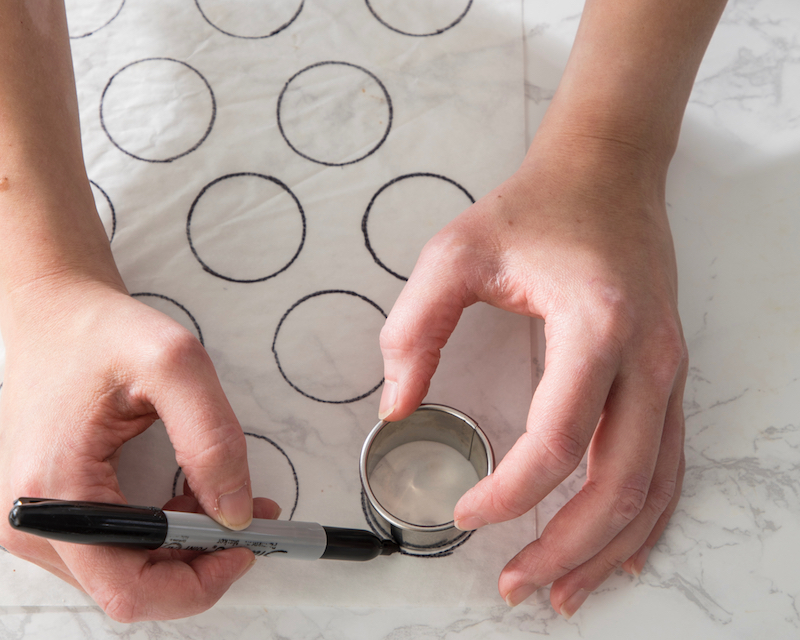
How: Line 2 to 3 rimmed baking sheets with nonstick baking mats. Using a permanent marker, draw 1½-inch circles 1 inch apart on a sheet of parchment paper. Place template under 1 nonstick baking mat.
Why: We use nonstick baking mats instead of parchment paper because the macaron shells can stick to parchment and not rise properly in the oven. Mats also allow for a clean release. Meanwhile, the template helps you keep your piping consistent and ensures each macaron shell is the same size.
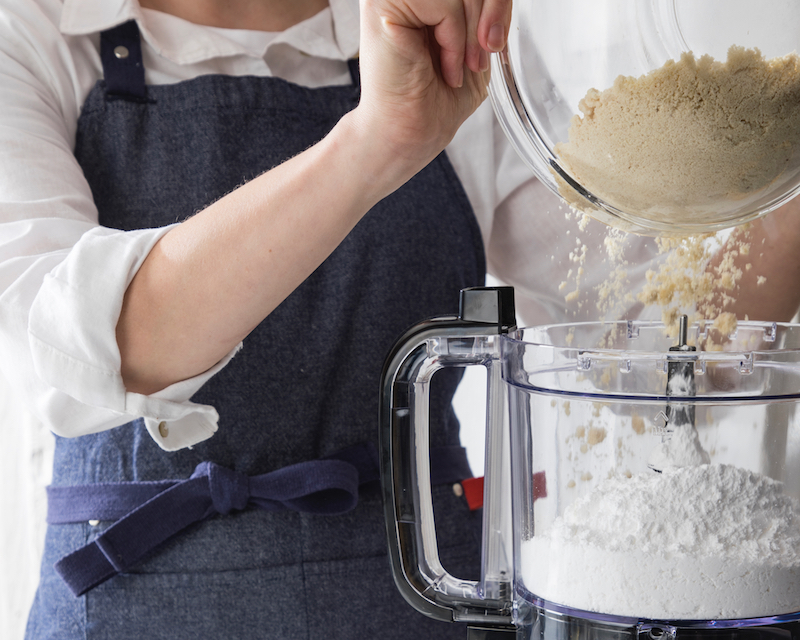
How: In the work bowl of a food processor, place confectioners’ sugar, flour, and salt; process until well combined. Sift confectioners’ sugar mixture using a fine- mesh sieve. (If you do not have a food processor, sift together confectioners’ sugar, flour, and salt three times.)
Why: The food processor will help remove any lumps and aerate the dry ingredients before you fold them into the egg white mixture. Specifically, the food processor speeds up the process, so you don’t have to sift the dry ingredients three times. However, if you don’t have a food processor, sifting three times will create the same results.
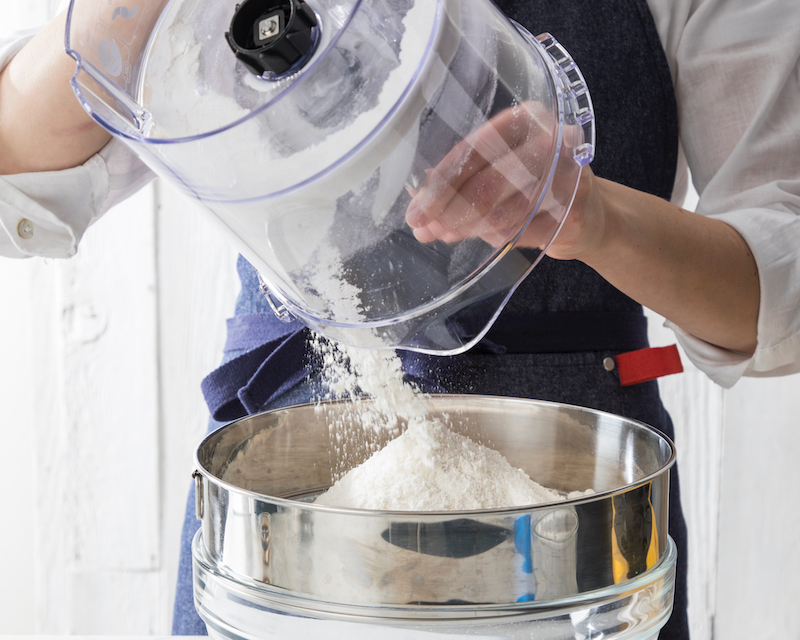
Expert tip: We love using a tamis sifter (pronounced “tammy”), a flat-bottomed sifter shaped similarly to a snare drum. Using a bowl scraper or a spatula, you can push and sift your dry ingredients into a large bowl with ease and very little mess.
Making Meringue Magic
Whip your egg whites into majestic, stiff peaks
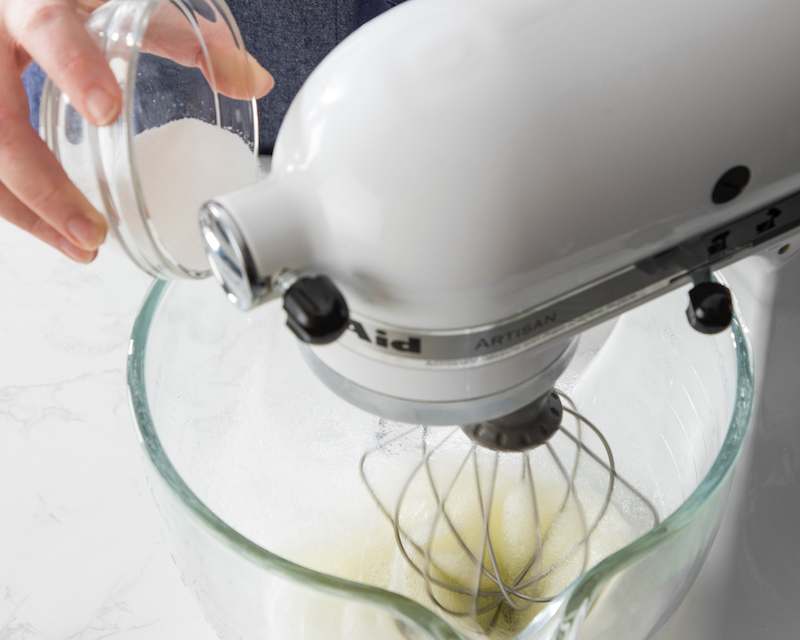
The Method: In the bowl of a stand mixer fitted with the whisk attachment, beat egg whites at medium-high speed until foamy, about 1 minute. When they are whisked, the proteins unravel and rise to the surface of the bubbles created and latch onto one another. A flexible film is formed, and the film is the meringue. Add granulated sugar in a slow, steady stream. Increase mixer speed to high and beat until stiff peaks form, about 2 minutes. Adding the sugar in a slow, steady stream allows it to be incorporated correctly and dissolve into the whites. If added all at once or too quickly, it will destroy the film you are trying to create.
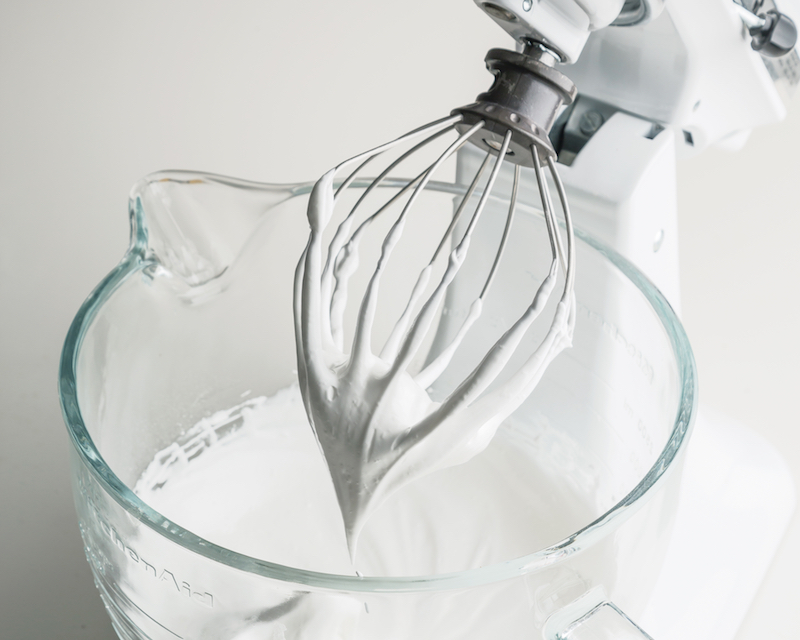
Stiff Peak Check: How do you know when your meringue is ready? You can overwhip your whites, which has negative effects on the cookies. Whites should be shiny and smooth, not grainy or dry. To know when you have proper stiff peaks, lift the whisk out and check to see if the peak points upward or only has a slight bend. You can also turn the bowl upside down, and if the meringue stays steadily in place and doesn’t fall out, you’ll know it’s ready. If your meringue starts to look clotted or textured, you have overwhipped it and should start the process over. Now that you’ve whipped it, use it immediately. Your meringue will begin to deflate and separate with every minute you wait.
Expert Tip: Any fat will interfere, so it is important that your hands, bowl, and whisk attachment are very clean. Also, when separating the eggs, you must ensure that no yolk gets into the whites. To combat this, separate your eggs when they are still cold, making it is easier to separate the white from the yolk.
Batter Up
The delicate process of incorporating your dry ingredients into your freshly whipped French meringue, demystified
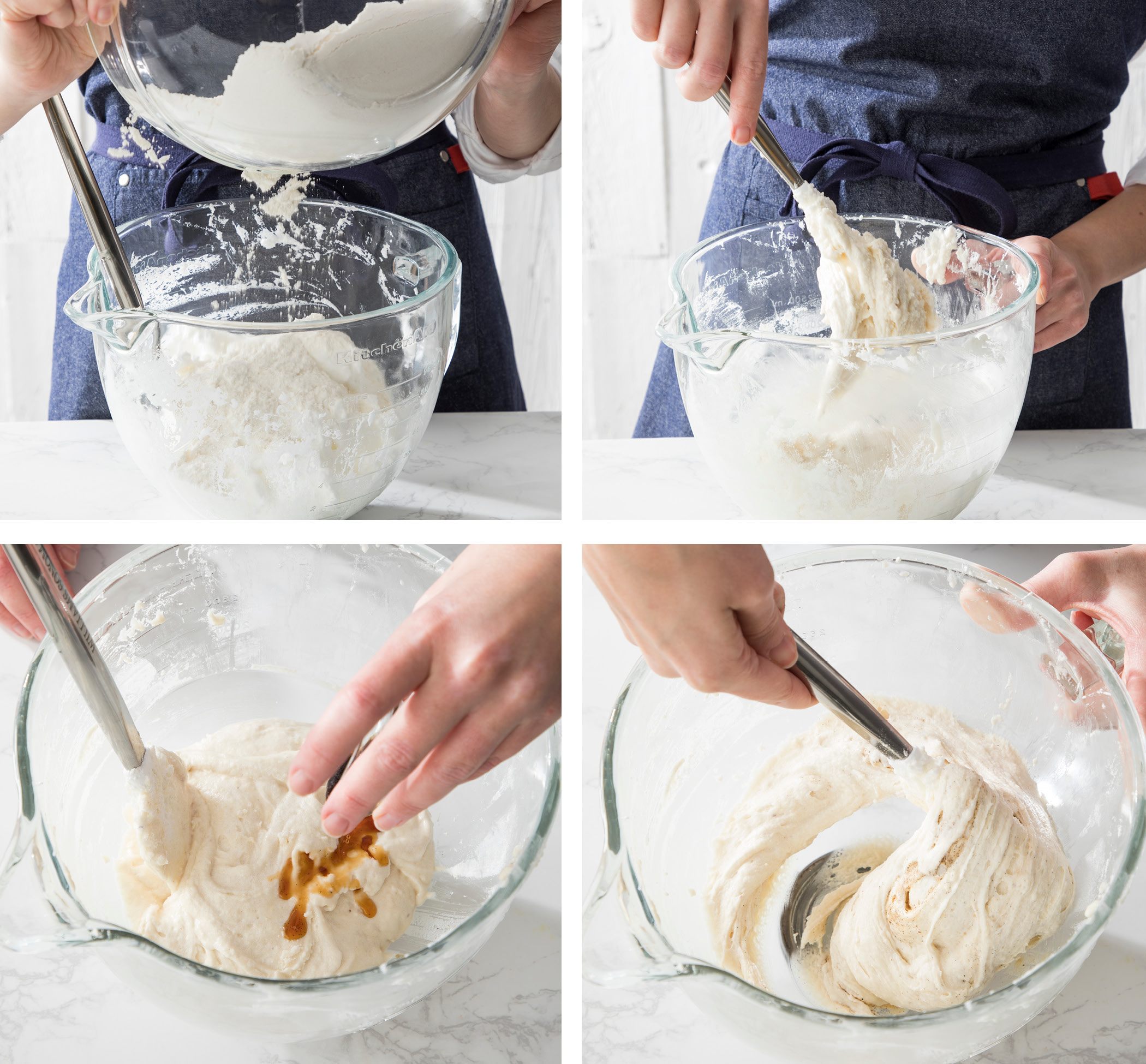
The Method: Gently fold in confectioners’ sugar mixture in three additions. Adding the confectioners’ sugar mixture slowly in three additions ensures an even and thorough incorporation into the batter. If you add it all at once, it will overwhelm the whites and will be too hard to fold in correctly. If the dry ingredients are not folding in easily, let the mixture stand for 30 seconds. This will give it time to hydrate and will make it easier to fold in. Right before mixture is completely combined, fold in vanilla bean paste and vanilla extract. Keep folding—lifting and tucking the mixture in a “J” motion—until you reach the ribbon stage. Properly folded macaron batter will move in a fluid, slow-moving ribbon, like sweet lava.
Perfecting Piping
Even pressure and steady hands are the keys to piping perfect macaron shells
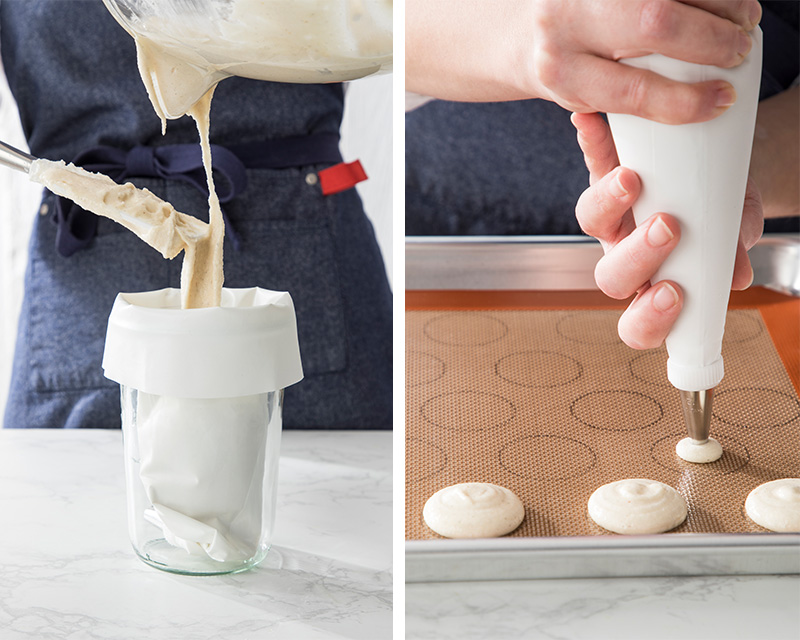
The Method: For a mess-free batter transfer, place piping bag in a large jar or glass and fold the bag edges over the lip of the glass before spooning in batter. Transfer batter to a piping bag fitted with a medium round tip (Ateco #804). Using a medium tip is important because if it is too big, it will not help push air out while the batter is being piped, leaving air bubbles in the batter. Holding tip perpendicular to pan, pipe batter onto drawn circles of template underneath mat. Apply pressure to bag, leaving tip stationary, until batter reaches drawn circle. If you move around while piping, the top won’t be smooth. Release pressure, and move piping tip in a quick circular motion as you finish piping each macaron shell to prevent a tip from forming on top. Remove template, and place under second baking mat to pipe batter. Repeat procedure with remaining batter. Slam pans vigorously on counter 5 to 7 times, rotating pan 180 degrees each time, to release air bubbles.
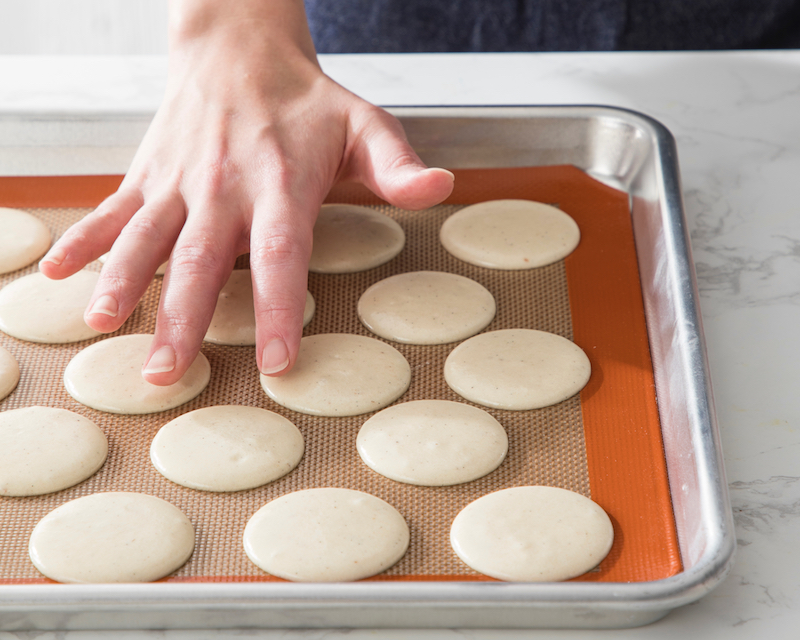
Rest Time: Let stand at room temperature until a skin forms on top of macaron shells, about 45 minutes to 1 hour. (The batter should feel dry to the touch and should not stick to your finger.) The time will depend on the environment in which it is resting. For example, if it is humid, it will take longer for the batter to set up. This wait time gives the cookies their signature crunchy shell and will help them develop a “foot.” (See Foot Check.)
Baking, Cooling, and Filling
Deconstructing the last three steps before you can enjoy macaron magic
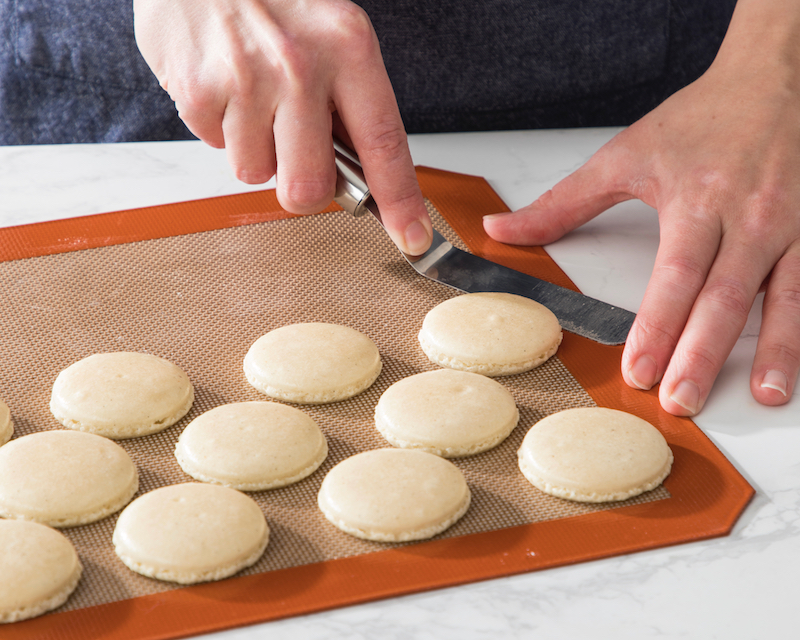
Baking: Preheat oven to 275°F (140°C). This low temperature helps keep the macaron shells from overbaking. Bake in batches until firm to the touch, 14 to 15 minutes, rotating pan every 5 minutes. The best way to know they are done is to try gently moving a top back and forth; if it moves, they need more time, but if it sticks, they are done.
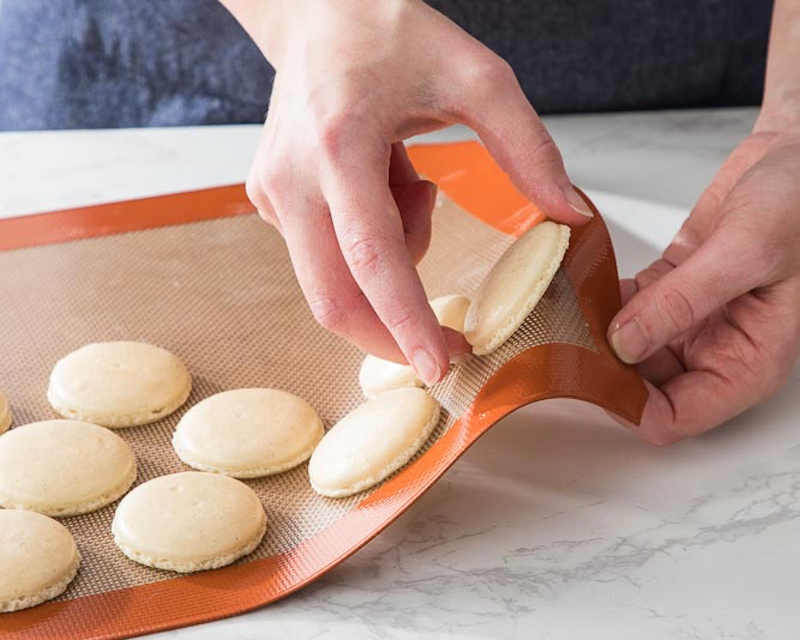
Foot Check: The “foot” of a macaron is the iconic indicator of a well-made and well-baked macaron. Resembling a frill or ruffle at the base of the shell, the foot should be pronounced but unbroken. If your foot is nonexistent, you might have overwhipped or underwhipped your meringue, and the oven temperature might not have been high enough to get the macarons to rise quickly. If the foot has spread out too much into a frothy-looking barrier, the oven temperature might have been too high, forcing the shells to spread instead of rise. It will take some understanding of your oven (use an oven thermometer) and meringue to get that ideal foot.
Cooling: Let cool completely on pans. If you try to move the macaron shells while they are still warm, they will not release from the baking mat. If you accidentally underbake and they are sticking, place the pan in the freezer for 15 minutes before trying to move them.
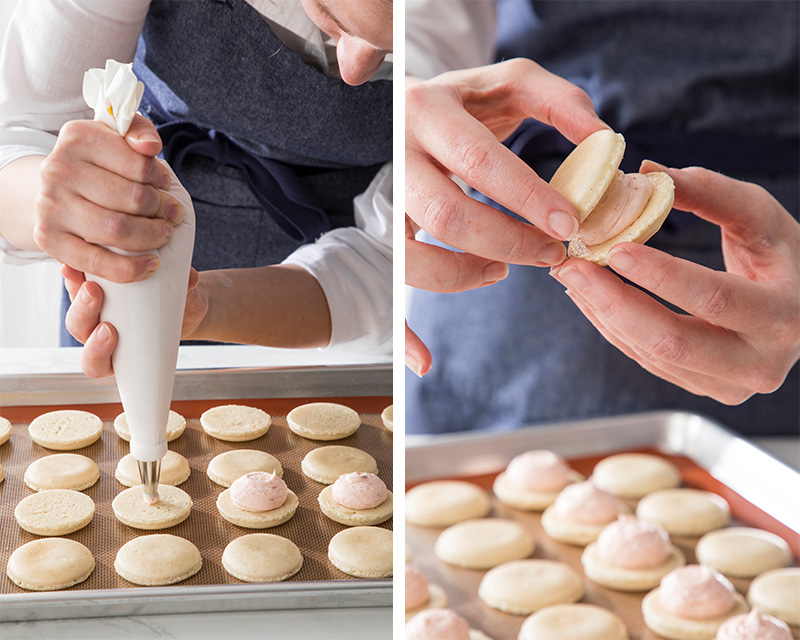
Filling: Place Strawberry Buttercream in a piping bag fitted with a small round tip (Ateco #802). Pipe buttercream onto flat side of half of macaron shells. Don’t fill completely, leaving a small border around the edges so the buttercream doesn’t overflow when you top it with the second macaron shell. Place remaining macaron shells, flat side down, on top of buttercream. To keep from crushing your macaron shells during assembly, hold them in your hands by their edges and gently press them together.
Expert Tip: Humidity can affect the fluffy rise of your meringue and the batter’s ability to dry out before baking, so it’s best to plan this baking project on a nice, dry day.

Thank you for sending this. Am looking forward to giving it a try. I did not receive a February lesson though…
Hi Pamela, we are so sorry that you have not receive February’s lesson. We have forwarded your email to our web editor and we will ensure that you receive all upcoming lessons.
I didn’t receive lesson 2 either, now that I think about it.
Hi Blythe, we are so sorry that you have not received February’s lesson. We have forwarded your email to our web editor and we will ensure that you receive all upcoming lessons. We’ll be in touch if we need any more information!
I didn’t receive a February lesson eithet
Hi Juliana, we are so sorry that you have not receive February’s lesson. We have forwarded your email to our web editor and we will ensure that you receive all upcoming lessons.
I didn’t receive February’s lesson. Please send email link
Hi Shay, we are so sorry that you have not receive February’s lesson. We have forwarded your email to our web editor and we will ensure that you receive all upcoming lessons.
Hello. I too did not receive anything for February
Hi Marie, we are so sorry that you have not received February’s lesson. We have forwarded your email to our web editor and we will ensure that you receive all upcoming lessons. We’ll be in touch if we need anything more information!
Thanks a lot!
dorothy sullivan
I did not receive a February lesson. Please send me information as to how I can obtain it. Thank you.
Hi Dorothy, we are so sorry that you have not received February’s lesson. We have forwarded your email to our web editor and we will ensure that you receive all upcoming lessons. We’ll be in touch if we need any more information!
I did not receive Feb lesson
Hi Elaine, we are so sorry that you have not received February’s lesson. We have forwarded your email to our web editor and we will ensure that you receive all upcoming lessons. We’ll be in touch if we need any more information!
I haven’t received March’s lesson. Came here after seeing you post on Instagram a couple days ago. Do you send them out in waves , or all at the same time? Friends who are also joining the fun got theirs.
Hi Deb, we are so sorry that you have not received this month’s lesson. We have forwarded your email to our web editor and we will ensure that you receive all upcoming lessons. We’ll be in touch if we need any more information!
I also did not receive an email with February’s lesson.
No February lesson here either.
I have really enjoyed getting this in the nicely formatted PDF file. I have been printing them and collecting them in the binder. Will this one be issued in that format?
Hey Kit,
Yes you can also print out a pdf for this recipe as well. Here is the link: https://bakefromscratch.com/wp-content/uploads/2020/03/Module-3.pdf
I was able to save the January and February module but am not seeing that option with the March. Am I missing something? Is there a way to save it?
Thank you,
Rozanne
Hey Anne,
You can always print the pdf here: https://bakefromscratch.com/wp-content/uploads/2020/03/Module-3.pdf
That way it’ll always be saved in your binder!
I have looked everywhere and cannot find February’s lesson. Please send.
I just joined up – is it possible to get previous lessons?
Hey Gail,
Yes you can get the rest of the recipes by going to the original Better Baking Academy page and scrolling down to our previous lessons. The ones that are available, January through March, can be clicked and viewed!
I have received all three months’ recipes but haven’t had time to make a single one yet. I am school librarian in Indiana and our governor announced yesterday that all schools would be closed until May 1st. I have no excuse now to not be baking.
I don’t see the link for the lesson PDF. Am I just missing it?
I have really enjoyed the March baking lesson. My first attempt at making macarons was not too successful, but my flat macaron shells still tasted delicious. My second attempt produced nice macarons and the filling is so yummy. I will make macarons over and over again.
Can you make every month a downloadable pdf? I was able to print January and February, but I would like to print each month. I don’t see where I can download the macarons. Thank you.
I didn’t receive the previous lessons either.
Hi Susan,
Thanks for reaching out! So sorry to hear that. It sounds like you may have unsubscribed to the mailing list, so if you navigate to this page, you can resubmit your email for updates! All of our lessons are also located at the bottom of this main page:
https://bakefromscratch.com/better-baking-academy/
[…] March: Spring Macarons […]