

Equipment
Bowl: A copper bowl would be ideal, but a deep, scrupulously clean glass, ceramic, or metal bowl will do as well. Plastic bowls are not recommended because the porous material soaks up oil and grease, keeping the egg whites from whipping up to their full potential.
Stand Mixer with a Whisk Attachment: The whisk attachment achieves better air in the egg whites than traditional beaters used with a handheld mixer.
Method
Start the mixer off on a low setting, moving up to a higher setting gradually. Beating too fast, too soon will keep your eggs from frothing properly before becoming a meringue.
Once the egg whites are foamy but not yet forming peaks, gradually add in sugar. If you add in the sugar too soon, before the foaming point, the meringue won’t whip up properly. Add it in too late, and your sugar won’t properly dissolve into the egg whites and will stay slightly gritty.
Continue to whip egg whites on high until glossy, stiff peaks are formed, with no droop or dip to your egg white peaks (refer to our images to see what a perfectly whipped meringue should look like).
Seeing is Believing

Underbeaten
This meringue won’t hold its volume in the oven and will deflate and crack. Drooping peaks and a slightly whipped cream-like appearance mean that you haven’t incorporated enough air and, thus, enough structure into your meringue yet.

Overbeaten
Because sugar is an excellent stabilizer for meringue, it’s harder to overbeat meringue. However, you can still create deflated meringue if it’s whipped too long. Essentially, overbeating the meringue will make the moisture wick out of the mixture, creating a granulated, grainy appearance. Pop this in the oven, and any air captured will pop and collapse.
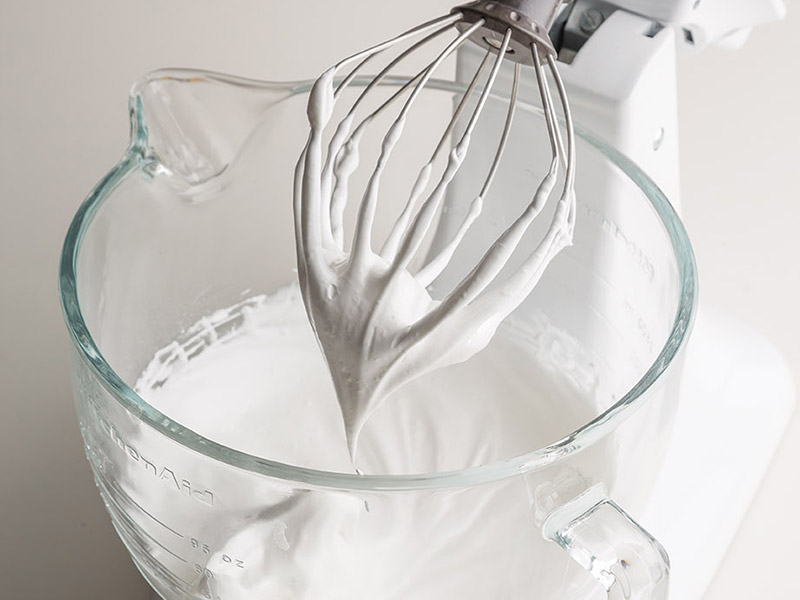
Just right
Shiny, stiff picks hold a rigid tip, and no sugar granules remain in the meringue. This should create the perfect French Meringue for your Pavlova (recipe in our 2018 March/April issue).
Separating Egg Whites
Crack your eggs on a flat surface, keeping the shell from breaking inward and into the egg. Shift the egg from one shell half to the other, letting as much egg white drip through as possible. Separating egg whites through your hands isn’t advised because the oils from your hands can transfer to the whites. If any trace of egg yolk makes it into the egg white mixture, remove it as best you can or discard the egg mixture completely. Any yolk will keep the whites from whipping properly.
Have been receiving the magazine for two years and LOVE it!!